GeoLab - geoscience and geoengineering laboratory
GeoLab is a geoscience and geoengineering laboratory equipped to study raw materials. For this purpose, GeoLab perform mineralogical, petrological, geochemical, geomechanical characterization and mineral and waste processing tests.
List of Analysis Methods and Equipments
Mineralogy, Petrology and Geochemistry
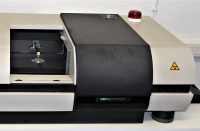
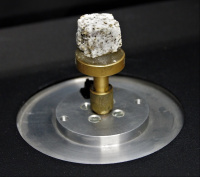
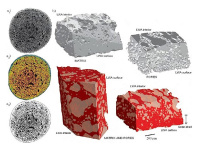
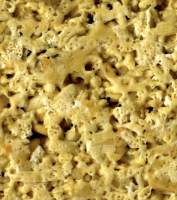
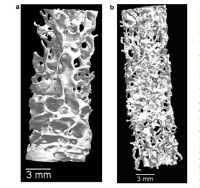
X-ray Microtomography System (SkyScan 1172 C)
Non-destructive method for small sample studies (maximum size 5 cm lenght x 2 cm diameter). Provides a 3D microscopy, in which in a single sampling step (without the need for preparation: cutting and or fine polishing) and processing of the digitized information, a model (virtual image) of the internal spatial structure of the sample can be obtained with high resolution (micrometric scale).It also possible to recover the "intact" sample at the end of the process.
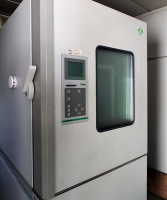
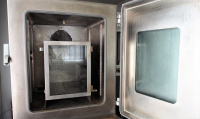
Climatic and Corrosion Chamber (Fitoclima 300 EDTU ARALAB)
Equipment that enables highly precise and reproducible conditions for humidity, temperature and gas, testing in many different domains.
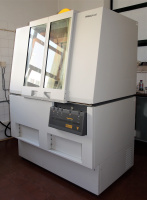
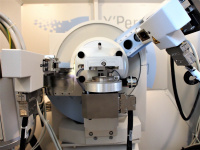
Difraction RX equipment (PANanalytical)
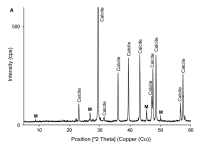
X-ray diffraction analysis (XRD) relies on the fact that different crystalline phases within a material generate distinct diffraction patterns. Identifying these phases involves comparing the X-ray diffraction patterns of unknown samples with those stored in reference databases. This technique is flexible, rapid, and non-destructive, providing comprehensive information about the crystallographic structure, chemical composition, and physical properties of a substance.
The minimal sample preparation needed is a significant factor contributing to the technique's popularity. It is well-suited for various applications, including industrial processes and materials research.
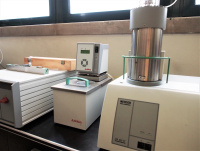
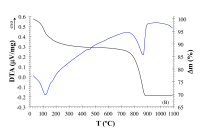
Thermogravimetric (TG) Calorimetric (Netzsch STA 409 PC LUXX)
Enables simultaneous thermogravimetric and calorimetric analyses of inorganic materials from room temperature into the high temperature range of 1650°C.
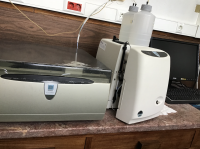
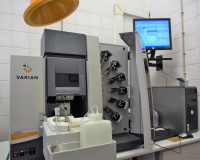
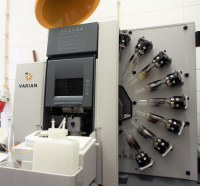
Ion Cromatography with Auto-sampler (DIONEX SP-2000i) and Atomic Absorption Spectrophotometer (VARIAN Fast Sequential AA280FS)
For anion and cation chemical analysis in waters, rocks, sediments, soil, and plants samples after physicochemical preparation.
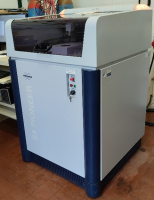
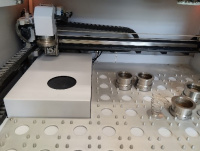
X-ray Fluorescence (XRF) – S4 Pioneer (Bruker)
X-ray Fluorescence (XRF) is a fast, non-destructive, multi-element method of analysis that relies on the interaction between X-rays and a sample. It enables both semi-quantitative and quantitative assessments of material composition and may be applied to solids, liquids, and powders. This technique finds application across a diverse range of materials such as ceramics, minerals, glasses, polymers, and metals, serving various industries including metallurgy, forensics, electronics, archaeology, environmental analysis, geology, and mining.
Geomechanics
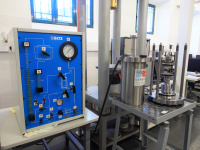
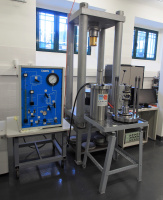
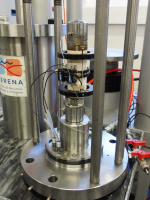
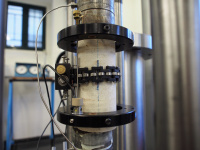
Triaxial Rock Testing System- High Pressure Triaxial Cell (GCTS HTRY-70)
With axial and circumferential deformation measurement system, platens with ultrasonic transducers for P- and S-wave velocity measurements.
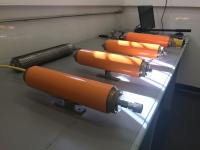
Core flooding
Test apparatus with core holders for measurements of permeability, relative permeability, saturation change, formation damage caused by fluids injection or interactions between the rock and the injected fluids (ageing), often used for Enhanced Oil Recovery (EOR).

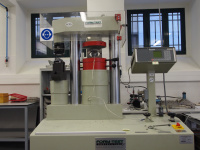
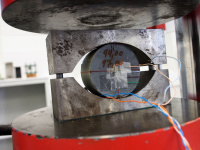
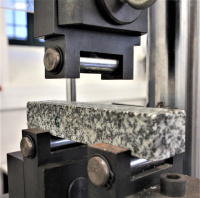
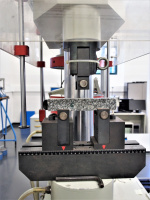
Compression Machine
For uniaxial, diametral (Brazilian), flexural tests to determine compressive and tensile strength. Accessories to evaluate deformability parameters (Young modulus and Poisson ratio).

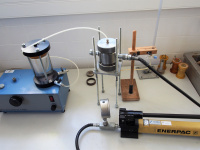
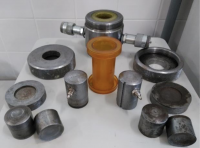

Constant pressure apparatus
To determine rock permeability and Hoek cell with end caps modified to allow measurement of strains and P- and S-waves.
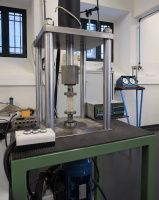
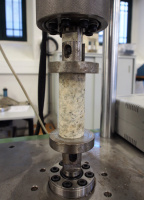
Direct Tensile Machine
For the determination of direct tensile strength on rocks.
Ore and Solid Waste Processing

Cutting Mill Retsch SM100
To reduce the particle size of soft, medium-hard, elastic and fibrous materials such as plastics, metals and wood. Sieves with 1mm-10 mm opening.

Rod and ball mills
To reduce the particle size of hard materials such as rocks, ceramics and bricks

Shaking table with vibrating feeder
To separate granulated materials based on their density or shape.

High Intensity Magnetic Separator
To separate materials based in their magnetic susceptibility.
Energy
In the Energy Group, we foster knowledge on three main areas: conventional fuels, alternative fuels and energy efficiency.
Environment
The Environment Group develops sustainable solutions for resource management, ecosystem restoration, and risk mitigation, working collaboratively with the Energy and Raw Materials Groups at CERENA.
Raw Materials
The Raw Materials Group researches sustainable mineral, non-mineral, and eco-innovative materials, collaborating with the Environment and Energy Groups and industry partners.